Where our MAD Talents are now
(Our alumni but can't find your name here? We want to hear from you! Email us for updates or inclusion now!)


CHATSWORTH MEDI@RT ACADEMY
Diploma in Content Creation and Digital Marketing

The Diploma in Content Creation and Digital Marketing program is designed to equip professionals with the essential skills required to excel in today’s rapidly evolving marketing and social media landscape.
With the growing importance of digital presence, businesses increasingly rely on skilled marketers and content creators who can engage audiences effectively through high-quality content and innovative strategies. This program addresses these demands by offering comprehensive training across the key areas sought after by employers in the marketing industry.
Tailored to meet the expectations outlined in current job descriptions for positions such as social media managers, digital marketers, and content creators, the course provides hands-on experience in critical areas like video editing, photography, digital marketing strategies (SEO, SEM, social media marketing), and content storytelling.
For those who have a traditional background in marketing, this program is especially valuable, providing the technical skills needed to remain competitive and relevant. It ensures that graduates will be able to master modern content creation tools and techniques, align with the expectations of employers, and be ready for the ever-changing digital landscape.
The Diploma in Content Creation and Digital Marketing is more than a credential—it's a career-shaping experience that prepares professionals to thrive in today’s dynamic marketing world.
Course Modules
Digital Imaging I: Adobe Photoshop and Lightroom
Digital Imaging, a contemporary dark room. In this class you will learn all the skills required to assist in your workflow process as a photographer or digital imaging artist. From basic skills and tools to more advanced techniques that will help you create works that are based on realism or surrealism. In this course you will learn practical techniques used by photographers and digital artists to produce work for commercial or artistic purposes, from on-camera work that will set you up for success when the image is processed in Photoshop.
Fundamentals of Photography
This module delves first into the history of photography and the documentation of its advancements. The technical skills needed to operate a DSLR/mirrorless camera in manual mode will then be taught through theoretical and practical means, giving students the trust and confidence to operate a professional camera. Through this course, students will also learn to develop and master the ‘eye’ for photography through assignment practice. The aim of this module is to equip students with the fundamental skills and techniques needed in order to operate a professional camera.
Natural and Studio Lighting
Photography is the practice of capturing light and shadow. In 1844, a photographic book was published titled the Pencil of Nature. The images published were entirely created without the aid of the artist’s pencil, meaning that the images, which were made with the Calotype/Talbotype technique, did not require direct intervention by human hands. Although Talbot had to position the camera obscura, prepare the light sensitive paper, and engage the shutter, the image created was indeed a product of nature, of light and shadow.
In this class, we will discover the various forms of light and how to manage and manipulate it to creating a body of work with both naturally occurring light and artificial light sources. Lessons also include working with studio lights to either be the main source of light or as a supplementary source for enhancement.
Digital Marketing
The Digital Marketing module is a comprehensive guide to the vital aspects of digital marketing, providing insights into web analytics, SEO, SEM, email marketing, and mobile marketing. The course aims to equip students with a strong understanding of digital marketing foundations, buyer journey, and strategic use of algorithms in search engines and social media platforms. It fosters the skills to create, implement, and analyze impactful digital marketing campaigns, while adhering to global data privacy laws.
Upon completion of this module, students will be able to design effective marketing strategies grounded in a clear understanding of digital marketing fundamentals. They will be adept at using analytics and keyword strategies, executing successful SEO and SEM campaigns, and creating impactful email and mobile marketing strategies. They will also be capable of navigating the ethical and legal dimensions of digital marketing. With hands-on practice throughout the course, students will be well-prepared to handle the dynamic challenges of the digital marketing industry.
Content Marketing and Creation (Storytelling)
The Content Marketing and Creation module dives into the creative aspect of digital marketing, emphasizing the potency of engaging and timely content. It shines a spotlight on the role of content marketing within an overarching digital strategy, outlining how to strategize, create, distribute, and measure content effectively.
By the module's conclusion, students will have honed their proficiency in creating various types of content, including short-form videos, real-time social media posts, memes, and viral content. They'll also master the art of weaving compelling narratives through storytelling and the development of persuasive content angles and hooks. Practical exercises coupled with tool recommendations equip students with hands-on experience, readying them for the industry. The module's climax — a student-developed content marketing campaign — serves as a testament to their acquired skills and strategic thinking capabilities.
TVC (Concept + Development)
The TVC (Television Commercial) Concept + Development module offers students a comprehensive journey through the world of TV advertising, from initial brainstorming to final execution. Prioritizing the conceptual and planning phases, students delve into the nuances of target audience analysis, scriptwriting, and storyboarding, harnessing both traditional techniques and innovative AI tools. They are also introduced to the foundational elements of production, including casting, shooting, and post-production essentials. By the course's conclusion, students emerge with a solid grasp of how to conceive, develop, and present impactful TV commercials, equipped for the modern, tech-enhanced advertising landscape.


M.A.D. GURUS
Our Lecturers stay abreast with their fast-evolving industries and impart their most up-to-date knowledge to students.


Kenji Choo
Academic Director,
Chatsworth Medi@rt Academy

Chelsea Chen
UX Lead, APAC, PayPal

Rob Gax
Founder, Mangham Gaxiola Mcgarry Bowen

Chris Frost
Founder & APAC CEO,
Cogs Agency Singapore
M.A.D. GURUS
Our Lecturers stay abreast with their fast-evolving industries and impart their most up-to-date knowledge to students.
Kenji Choo
Academic Director,
Chatsworth Medi@rt Academy
Chelsea Chen
UX Lead, APAC, PayPal
Rob Gax
Founder, Mangham Gaxiola Mcgarry Bowen
Chris Frost
Founder & APAC CEO,
Cogs Agency Singapore
Mode
Face-to-face / In-person
Manner of Delivery
Lecture-based / Hands-on / Interactive
Assessment
Assignment-based / Presentation
Graduation Criteria
Students are required to attain a passing grade for all modules. The passing grade for each module is 50 marks and above.
Entry Requirements
Singaporean / PR
For Others (With Valid VISA)
-
Applicants are to be aged 16 or above when applying
-
GCE ‘O” level with minimum 3 credits (C6) or equivalent
-
GCE ‘O’ level with minimum of C6 for English or equivalent
-
Applicants not meeting the entry requirements will need to undergo an interview
-
VIETNAM - Minimum year 10 education
-
CHINA - High School Senior Level 2 or equivalent
-
INDONESIA - SMU2
-
MALAYSIA - SPM / STPM / Chinese Independent – High School Senior Level 2
-
At least 'O' Level English (C6) or equivalent
*Exemption will be considered for applicants with related working experience or graduates from other design schools. (Exemption for design modules is strictly based on portfolio evaluation and interview)
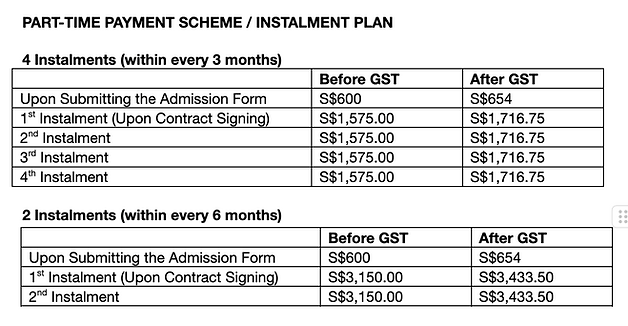
Course Fees

Why us?


